


NXP Semiconductors LPC1778 & LPC1788 32-bit Microcontrollers
NXP Semiconductors LPC1778 and LPC1788 32-bit Microcontrollers are Arm® Cortex®-M3 MCUs ideal for for embedded applications requiring a high level of integration and low power dissipation. The Arm Cortex-M3 CPU incorporates a 3-stage pipeline and has a Harvard architecture with separate local instruction and data buses, as well as a third bus with slightly lower performance for peripherals. The Arm Cortex-M3 CPU also includes an internal prefetch unit that supports speculative branches. The LPC1778 and LPC1788 MCUs add a specialized flash memory accelerator to accomplish optimal performance when executing code from flash. These devices operate at up to 120MHz CPU frequency.
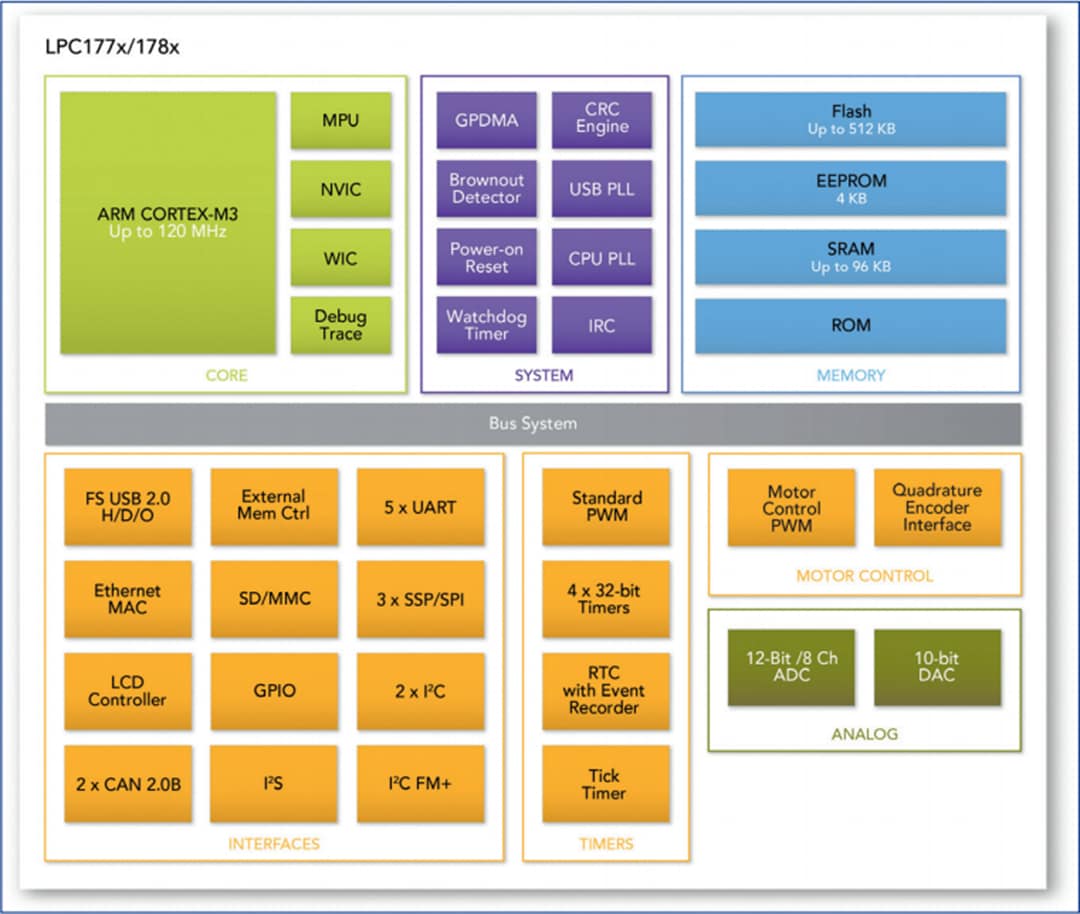
The peripheral complement of the LPC1778 and LPC1788 MCUs includes up to 512kB of flash program memory, up to 96kB of SRAM data memory, up to 4032 byte of EEPROM data memory, External Memory Controller (EMC), LCD (LPC178x only), Ethernet, USB
Device/Host/OTG, a General Purpose DMA controller, five UARTs, three SSP controllers, three I2C-bus interfaces, a Quadrature Encoder Interface, four general purpose timers, two general purpose PWMs with six outputs each and one motor control PWM, an ultra-low power RTC with separate battery supply and event recorder, a windowed watchdog timer, a CRC calculation engine, up to 165 general purpose I/O pins, and more.
The analog peripherals include one eight-channel 12-bit ADC and a 10-bit DAC.
The pinout of the LPC1778 and LPC1788 MCUs is intended to allow pin function compatibility with the LPC24xx and LPC23xx.
Features
- Functional replacement for LPC23xx and 24xx family devices
- System
- Arm Cortex-M3 processor, running at frequencies of up to 120MHz
- Arm Cortex-M3 built-in Nested Vectored Interrupt Controller (NVIC)
- Multilayer AHB matrix interconnect provides a separate bus for each AHB master
- Split APB bus allows for higher throughput
- Cortex-M3 system tick timer, including an external clock input option
- Standard JTAG test/debug interface, Serial Wire Debug and Serial WireTrace Port
- Emulation trace module supports real-time trace
- Boundary scan for simplified board testing
- Non-maskable Interrupt (NMI) input
- Single 3.3V power supply (2.4V to 3.6V)
- Memory
- 512kB on-chip flash program memory
- 96kB on-chip SRAM
- 4kB on-chip EEPROM
- In-System Programming (ISP) and In-Application Programming (IAP) capabilities
- LCD controller, supporting both STN and TFT displays
- External Memory Controller (EMC)
- Eight channel General Purpose DMA controller (GPDMA)
- Serial Interfaces
- Ethernet MAC with MII/RMII interface and associated DMA controller
- USB 2.0 full-speed dual port device/host/OTG controller with on-chip PHY and DMA
- Five UARTs with fractional baud rate generation
- Three SSP controllers with FIFO and multi-protocol capabilities
- Three enhanced I2C-bus interfaces
- I2S (Inter-IC Sound) interface for digital audio input or output
- CAN controller with two channels
- Digital Peripherals
- SD/MMC memory card interface
- Up to 165 General Purpose I/O (GPIO) pins
- Two external interrupt inputs configurable as edge/level sensitive
- Four general purpose timers/counters
- Quadrature encoder interface that can monitor one external quadrature encoder
- Two standard PWM/timer blocks with external count input option
- Real-Time Clock (RTC) with a separate power domain
- Windowed Watchdog Timer (WWDT)
- Analog peripherals
- 12-bit Analog-to-Digital Converter (ADC) with conversion rates up to 400kHz
- 10-bit Digital-to-Analog Converter (DAC)
- Power Control
- Four reduced power modes: Sleep, Deep-sleep, Power-down, and Deep power-down
- Wake-up Interrupt Controller (WIC)
- Processor wake-up from Power-down mode via any interrupt
- Brownout detect with separate threshold for interrupt and forced reset
- On-chip Power-On Reset (POR)
- Clock
- On-chip crystal oscillator with an operating range of 1 MHz to 25 MHz
- 12MHz Internal RC oscillator (IRC) trimmed to 1% accuracy
- Unique device serial number for identification purposes
- Operating temperature range: -40°C to 85°C
- Package options:
- LQFP-144
- LQFP-208
- TFBGA-180
- TFBGA-208
Applications
- Communications
- Point-of-sale terminals, web servers, multi-protocol bridges
- Industrial/Medical
- Automation controllers, application control, robotics control, HVAC, PLC, inverters, circuit breakers, medical scanning, security monitoring, motor drive, video intercom
- Consumer/Appliance
- Audio, MP3 decoders, alarm systems, displays, printers, scanners, small appliances, fitness equipment
- Automotive
- After-market, car alarms, GPS/fleet monitors
Videos
Related Products
NXP Semiconductors LPC 32位Arm®技术微控制器
可实现高性能应用并为开发人员带来出色体验。
Block Diagram